
Last month, one of the major AI providers had an outage. Their API returned 503s for about two hours. Our tests kept running without a hiccup.
That's not luck. That's architecture.
The single-provider trap
When you're building AI-powered features, it's tempting to pick one provider and go all-in. OpenAI has great docs. Anthropic has Claude. Google has Gemini. Pick your favorite, integrate it, ship it.
This works until it doesn't.
AI APIs go down. Rate limits hit at the worst times. New models get released and your hardcoded model name suddenly returns deprecation warnings. Costs change. Quotas get adjusted. That one model you built your entire product around gets discontinued with 30 days notice.
We've seen all of this happen. Sometimes in the same week.
Enter OpenRouter
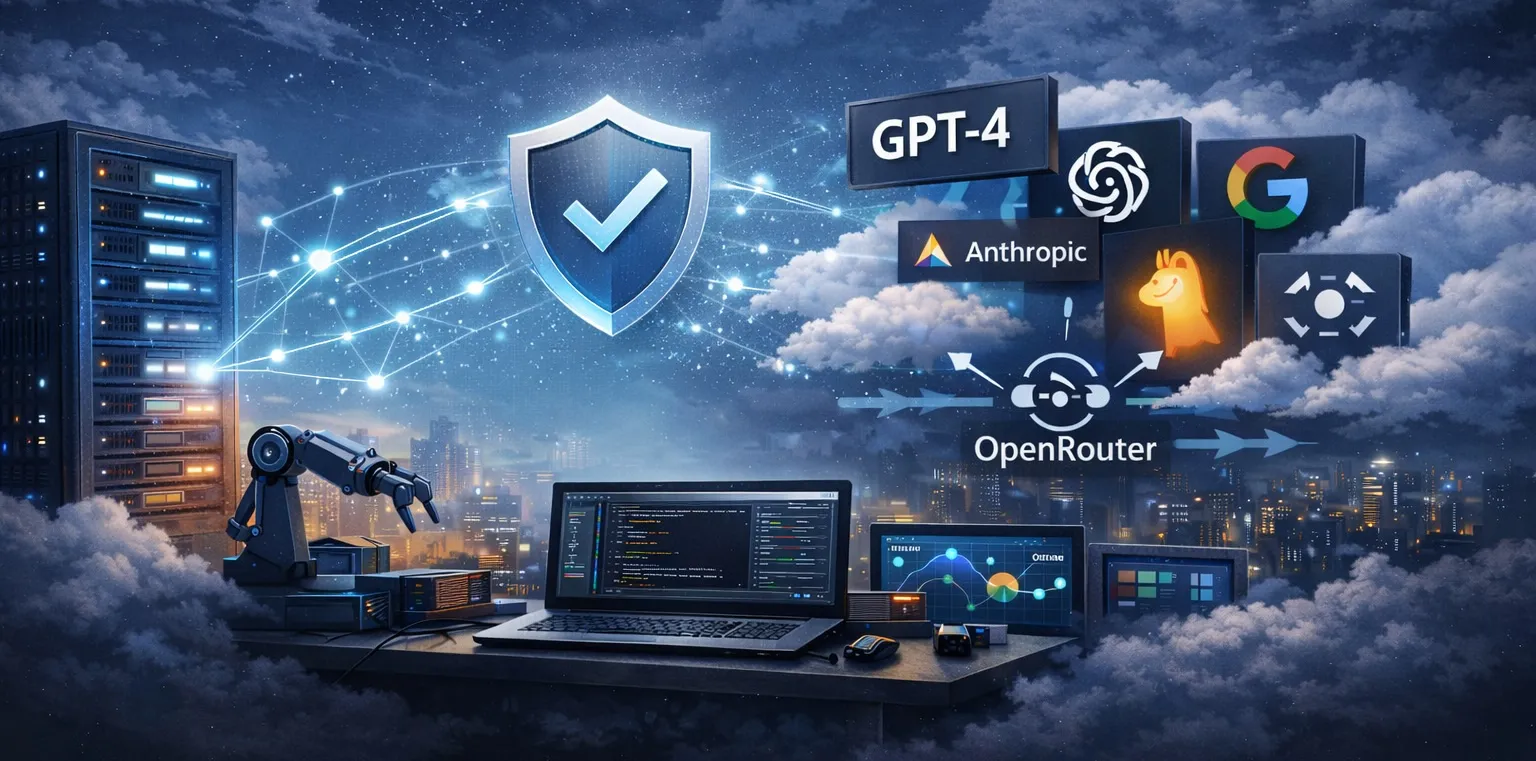
OpenRouter solves this problem in a way that feels almost too simple: one API, dozens of providers.
You send your request to OpenRouter. They route it to the provider you specify (or let them pick the best option). You get your response. Same interface whether you're hitting Claude, GPT-4, Gemini, Llama, Mistral, or any of the 200+ models they support.
But here's what makes OpenRouter genuinely valuable for production systems:
Unified billing. One account, one invoice, access to every major AI provider. No juggling five different API keys and billing dashboards. No "which account did we hit the limit on this time?"
Automatic fallbacks. If one provider goes down, OpenRouter can route to alternatives. You can set this up explicitly or let their system handle it. Either way, your users don't see errors.
Model flexibility. Want to A/B test Claude against GPT-4? Same code, different model string. Want to try the latest Llama release? It's probably already available. No SDK updates, no code changes.
Transparent pricing. They add a small margin on top of provider costs. That's the business model. No hidden fees, no surprises on your bill.
How we use it at Test-Lab
Our AI testing agents need to be reliable above all else. A flaky test runner is worse than no test runner.
Here's our setup:
Primary model selection. We pick the best model for each task based on cost, speed, and capability. Quick tests get faster, cheaper models. Deep tests get the heavy hitters.
Fallback chains. If Claude is down or rate-limited, we fall back to GPT-4. If that's having issues, we have a third option. All of this happens automatically.
Model upgrades. When we detect the agent is stuck or producing low-quality outputs, we can hot-swap to a more capable model mid-run. OpenRouter makes this trivial since it's just a different model string.
Cost tracking. OpenRouter's dashboard shows us exactly what we're spending per model, per day. Makes it easy to optimize without guessing.
The practical benefits
Since switching to this multi-provider architecture:
Zero AI-related outages. Provider issues happen. We just route around them.
Better cost efficiency. We're not locked into one provider's pricing. When one raises prices, we have options.
Faster model adoption. New model drops on Tuesday, we're testing it on Wednesday. Sometimes we're using it in production by Thursday.
Simpler codebase. One SDK, one set of types, one way to handle responses. The OpenRouter format is OpenAI-compatible, so our existing code worked with minimal changes.
What about direct integrations?
Fair question. Why not just integrate with each provider directly?
You can. We did, initially. Here's what that looked like:
- Five different SDKs with different APIs and quirks
- Five sets of credentials to manage
- Five different error formats to handle
- Model-specific code paths everywhere
- Billing reconciliation across multiple providers
It was a mess. Every time we wanted to try a new model, it was a day of integration work.
With OpenRouter, adding a new model is literally changing a string. The cognitive overhead disappeared.
When single-provider makes sense
To be fair, there are cases where going direct makes sense:
- You have a negotiated enterprise deal with specific pricing
- You need features only available in one provider's SDK (function calling was like this for a while)
- You're doing fine-tuning and need tight integration with one platform
- Volume discounts make the routing layer overhead significant
For everyone else, especially early-stage teams building AI products, the multi-provider approach saves headaches.
Getting started
If you're considering this architecture:
-
Start with OpenRouter. Sign up, get an API key, point your existing OpenAI-compatible code at their endpoint. Most things just work.
-
Pick a primary model. Run your workload on a few options, measure quality and cost, pick a default.
-
Add fallbacks. OpenRouter supports this natively. Or build simple retry logic that tries alternative models on failure.
-
Monitor costs. Their dashboard is solid. Keep an eye on what you're actually spending.
-
Stay flexible. The AI landscape changes fast. What's best today might not be best in six months. Multi-provider architecture means you can adapt without rewriting code.
Shoutout to the OpenRouter team
We've been using OpenRouter from the start. The service has been rock solid. When we've had questions, their support has been responsive and helpful. They're building real infrastructure for the AI ecosystem, not just another wrapper.
If you're building production AI systems, give them a look. It's one of those tools that makes you wonder why you ever did it the hard way.
Test-Lab uses OpenRouter to power our AI testing agents. Try it out and see AI-powered testing in action.