
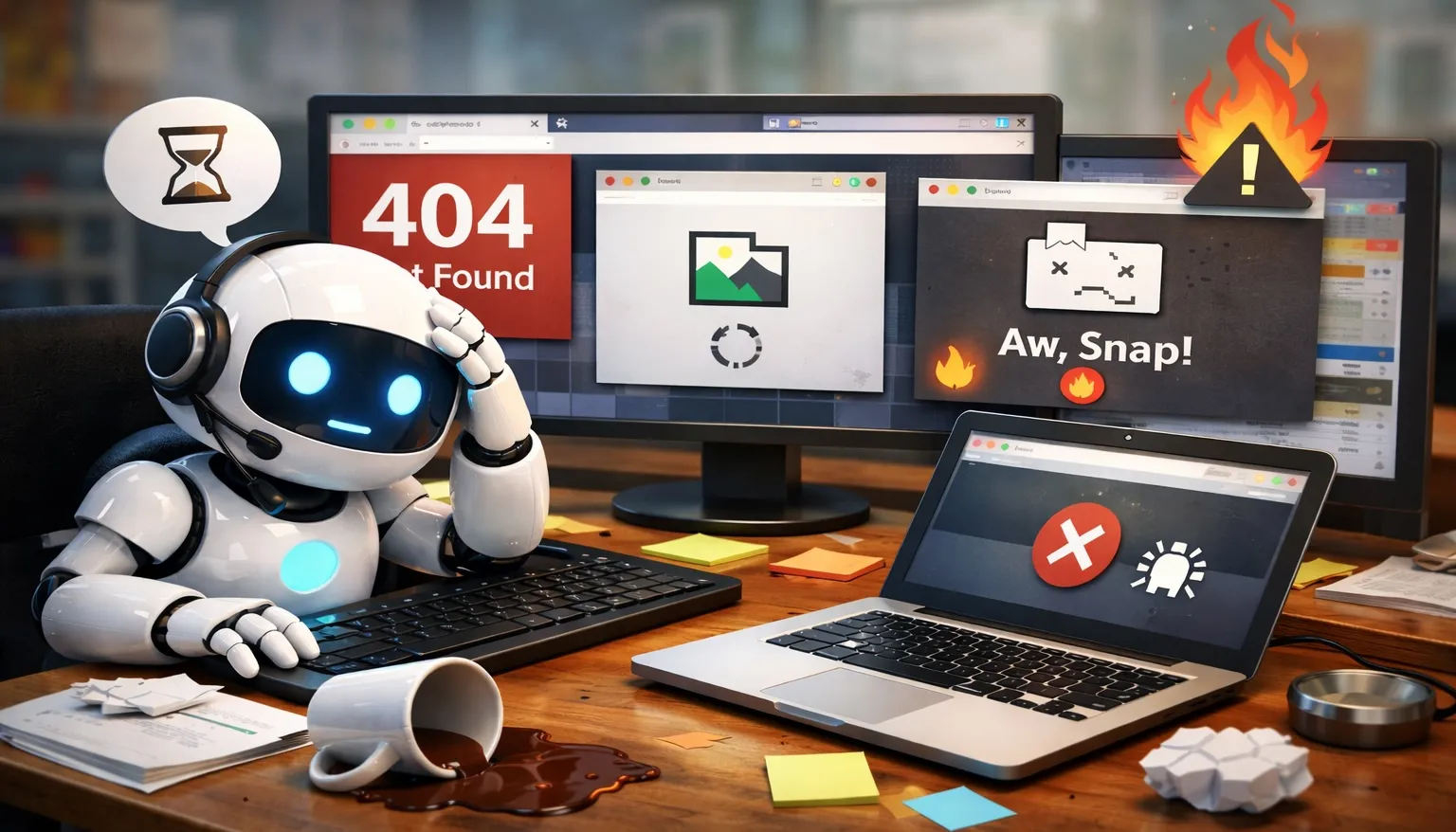
Every week there's a new AI agent promising to automate everything. Browse the web. Fill out forms. Click buttons. They demo beautifully on Twitter. Then you try to run them in CI at 3am and they fail spectacularly.
We've spent the last year figuring out why - and building something that actually works.
The promise vs. reality gap
AI agents have gotten remarkably good at reasoning. Give Claude or GPT-4 a complex problem and they'll think through it methodically. But browser-based QA isn't primarily a reasoning problem. It's a reliability problem.
Here's what happens when you point a generic AI agent at a web app:
The DOM changes out from under you. Agent takes a snapshot, decides to click a button, but while it was thinking, a loading spinner appeared and shifted the layout. Click lands on the wrong element. Test fails.
Stale element references. The agent captured ref="button-42" but then a modal opened. Now button-42 is hidden behind an overlay. The agent doesn't know this because it's working from old data.
Infinite action loops. Something goes wrong. The agent tries to recover. Its recovery attempt triggers the same error. Loop forever until timeout.
Context window overflow. Long test runs accumulate history. Screenshots, DOM snapshots, action logs. Eventually the context gets so bloated the model starts hallucinating or losing track of the original objective.
These aren't edge cases. This is what happens constantly when you try to use general-purpose agents for QA.
Why "just use an LLM" doesn't work
The LLM itself isn't the problem. Models are smart enough. The problem is everything around them.
Generic agents are built for flexibility. They need to handle coding, browsing, file operations, API calls - whatever you throw at them. That flexibility comes with overhead: large system prompts, multiple tool definitions, abstraction layers. For QA testing, most of that is dead weight.
Prompts aren't optimized for testing. A general agent's prompt says "help the user accomplish their goal." A QA agent's prompt should say "verify this specific behavior, capture evidence, report failures clearly, don't get stuck." Different jobs need different instructions.
No recovery mechanisms. When a test step fails, what should happen? Retry? Skip? Abort? General agents don't have opinions about this. QA agents need strong opinions.
No awareness of test semantics. Is the agent stuck or is the page just slow? Did the test pass or did the agent give up? Is this a real bug or a flaky test? These distinctions matter enormously for QA and generic agents don't understand them.
What makes QA testing different
Browser testing is an adversarial environment. Pages load slowly. Elements appear and disappear. JavaScript mutates the DOM constantly. Networks fail. Servers return errors.
A good QA agent needs to:
- Stay synchronized with the browser state - not work from stale snapshots
- Handle timing gracefully - wait for things, but not forever
- Detect when it's stuck - and do something about it
- Produce consistent results - flaky tests are worse than no tests
- Generate actionable reports - "test failed" isn't enough
These requirements push you toward a purpose-built system. You can't just wrap an LLM in a browser automation library and call it a day.
How we handle the hard parts
At Test-Lab, we've built specific mechanisms for each failure mode. We're not going to detail the exact implementations - that's our secret sauce - but here's the shape of it:
Stuck detection. Our system monitors for repetitive behavior patterns. If the agent is trying the same thing repeatedly without progress, we detect it and intervene. Sometimes that means retrying with different context. Sometimes it means escalating to a more capable model. Sometimes it means stopping gracefully with a clear error.
Model hot-swapping. Not every test needs GPT-4. Simple navigation tests work fine with faster, cheaper models. But when things get complicated - unusual UI patterns, tricky state management, edge cases - we can upgrade mid-run. The system makes this decision automatically based on what's happening.
Context management. We're ruthless about what goes into the context window. Every token costs money and attention. Our system keeps what matters, summarizes what might matter, and drops what doesn't. Long test runs don't accumulate garbage.
Evidence capture. Screenshots, DOM snapshots, and action logs are captured at key moments - not constantly. When a test fails, you get the evidence you need to debug it. When a test passes, you're not drowning in irrelevant screenshots.
Graceful degradation. AI providers go down. Rate limits hit. Models return garbage sometimes. Our system handles all of this transparently. Fallback providers, automatic retries, quality checks on outputs.
Security-first architecture
Here's something that doesn't get enough attention: most AI testing tools pass your credentials through their LLM.
Think about that. You give them your session tokens, API keys, login credentials. Those get embedded in prompts, sent to cloud AI providers, potentially logged, potentially cached, potentially leaked.
We do it differently.
Your credentials never touch the LLM. When you configure authentication - whether that's cookies, headers, or anything else - we inject those directly into the browser instance. The AI agent sees a logged-in browser. It doesn't know how it got logged in. It never sees the credentials.
This isn't just paranoia. It's the right architecture:
- Credentials stay on our infrastructure - not sent to third-party AI providers
- Nothing to leak in prompts - even if prompts were somehow exposed
- No accidental logging - credentials can't appear in conversation logs
- Audit-friendly - clear separation between auth and AI reasoning
If you're testing production systems with real user accounts, this matters. A lot.
The competitive landscape
There are other players in this space. Some take the "give LLM browser access" approach and hope for the best. Some build elaborate rules-based systems that don't really use AI at all. Some focus on visual regression without understanding behavior.
The common thread is that they're either too generic (all the LLM limitations we discussed) or too narrow (can't handle the variety of real applications).
We're trying to hit a different spot: AI that's genuinely intelligent about testing, wrapped in infrastructure that makes it reliable enough for production CI.
What this means for you
If you've tried AI testing tools and found them unreliable, that's not because AI can't do testing. It's because general-purpose tools aren't built for this job.
QA automation needs:
- Purpose-built agents with testing-specific reasoning
- Robust error handling and recovery
- Smart context management for long-running tests
- Security architecture that protects credentials
- Production-grade infrastructure (fallbacks, retries, monitoring)
That's what we've built. No scripts to write. No infrastructure to manage. Just describe what to test and we handle the complexity.
The state of AI for QA in 2026: it works, but only if you build for it specifically.
See AI testing that actually works. Try Test-Lab free and run your first test in minutes.
Shopping the market first? See our ranked, honest guide to the best AI QA tools in 2026.