
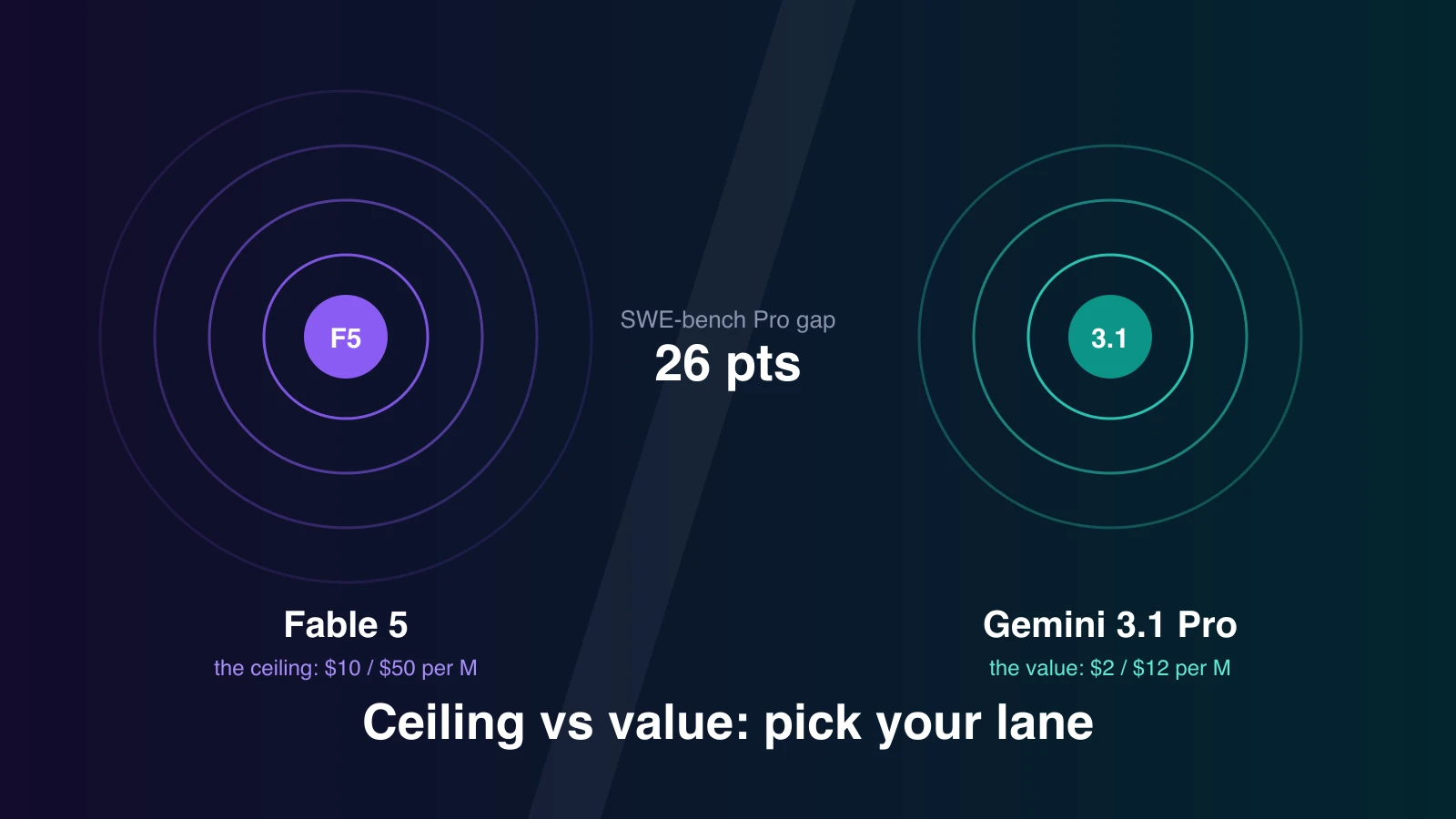
Fable 5 vs Gemini 3.1 Pro is not a fair fight, and that is exactly why it is the right comparison. One is Anthropic's Mythos-class flagship at $10 per million input tokens. The other is Google's workhorse at $2, the strongest price-performance model of the current generation. Nobody is choosing between them on quality alone; they are choosing where on the cost-capability curve to sit. Here is where each one actually earns its spot, on coding and on browser automation, based on the public benchmarks and our own harness runs.
The gap on paper
From the launch-day tables we compiled in our four-model breakdown:
| Benchmark | Fable 5 | Gemini 3.1 Pro |
|---|---|---|
| SWE-bench Pro | 80.3% | 54.2% |
| Terminal-Bench 2.1 | 88.0% | 70.7% |
| OSWorld-Verified (computer use) | 85.0% | 76.2% |
| GDPval-AA (knowledge work, Elo) | 1932 | 1314 |
And the rate cards:
| Model | Input $/M | Output $/M | Notes |
|---|---|---|---|
| Fable 5 | $10 | $50 | Thinking always on, 1M context, no long-context surcharge |
| Gemini 3.1 Pro | $2 | $12 | $4 / $18 above 200K context |
Twenty-six points on SWE-bench Pro is the largest quality gap in any mainstream two-model comparison right now. A 5x input price gap is also the largest. The whole decision lives in that tension.
Coding: the ceiling is real
On hard software work there is no framing that rescues Gemini 3.1 Pro. Fable 5's launch benchmarks put it in new territory (95.0% SWE-bench Verified, more than double Opus 4.8 on FrontierCode Diamond), and the daily-use reports match: multi-file refactors done in one pass, long sessions that stay coherent, frontend output that needs less cleanup.
Gemini 3.1 Pro's honest position is different: it is the model you use when the task does not need the ceiling. Glue code, routine fixes, summarization, classification, high-volume pipelines: at a fifth of the input price it does the job and the invoice stays boring. The mistake is not using Gemini 3.1 Pro; the mistake is using it on the 10% of tasks where its failure costs more than Fable 5's premium.
One practical note on cost mechanics: Fable 5 will not let you disable thinking, so its effective multiplier on simple tasks runs above the 5x sticker. Pointing it at easy work is the most expensive way to own it.
Browser automation: closer than the leaderboards suggest
This is where the comparison gets interesting, because browser work does not track coding benchmarks. When we ran 11 frontier models through our benchmark harness against a hardened production test plan, Gemini 3.1 Pro passed 100% of runs at an average of $0.24 per run, one of the best value scores in the smart tier. Browser-step execution rewards reliability and clean tool use more than raw depth, and Gemini 3.1 Pro has both.
Fable 5's computer-use gain over its own stablemate Opus 4.8 was 1.6 points on OSWorld-Verified; against Gemini 3.1 Pro the gap is wider (85.0 vs 76.2), and it shows up exactly where you would expect: long multi-page journeys, ambiguous UI states, recovery after something unexpected. On a routine 10-step plan, both models click the same buttons and pass, and one of them costs an order of magnitude more per run once always-on thinking is in the bill.
So the browser verdict is a split: Gemini 3.1 Pro is a legitimate default execution model for high-volume test steps, and Fable 5 is the escalation model for planning, healing, and the journeys that break everything else. That is not diplomatic hedging; it is how a cost-aware testing stack actually deploys them, and it is how we run model selection inside Test-Lab.
Context windows and long sessions
Both models take long context seriously, with different personalities. Fable 5 ships a 1M window with no long-context surcharge and its headline strength is staying coherent across enormous agentic sessions. Gemini 3.1 Pro charges a stepped rate above 200K ($4/$18) and remains excellent at high-volume retrieval-style work. For agent builders the practical difference is that Fable 5's long-horizon coherence is the product, while Gemini's long context is a spec.
When to use which
Use Fable 5 when:
- The task defeats cheaper models, or takes them multiple attempts
- Sessions run long and coherence at step 40 matters more than cost at step 4
- You are generating test plans or diagnosing failures, where one strong pass is the whole job
Use Gemini 3.1 Pro when:
- Volume is high and the per-run bill is the constraint
- The work is routine browser-step execution or bread-and-butter coding
- You want frontier-adjacent quality with the cheapest serious rate card
Frequently asked questions
Is Fable 5 better than Gemini 3.1 Pro?
On capability, yes, by the widest margin of any current mainstream comparison: 26 points on SWE-bench Pro and 9 points on OSWorld-Verified. On price-performance for routine work, Gemini 3.1 Pro wins, at a fifth of the input price and a proven 100% pass rate on our production browser-testing benchmark.
Which is better for AI browser testing?
For executing routine test steps at volume, Gemini 3.1 Pro: equal pass rates at a fraction of the cost. For generating plans, healing broken runs, and finishing long complex journeys, Fable 5. Production stacks should use both, routed by step difficulty.
Is Gemini 3.1 Pro good enough for coding agents?
For routine and mid-difficulty work, yes. Its 54.2% SWE-bench Pro puts a real ceiling on hard autonomous coding, so teams typically pair it with a stronger escalation model rather than run it alone.
Test-Lab benchmarks every frontier release on real production test plans and routes each step to the model that earns it. Run your first AI browser test free.
Related reading:
- Fable 5 vs Opus 4.8 - the inside-Anthropic version of this decision
- Claude Fable 5 vs Opus 4.8 vs GPT-5.5 vs Gemini 3.1 Pro - the full launch analysis
- Which LLM is best for browser automation? - the harness data behind the browser verdict