
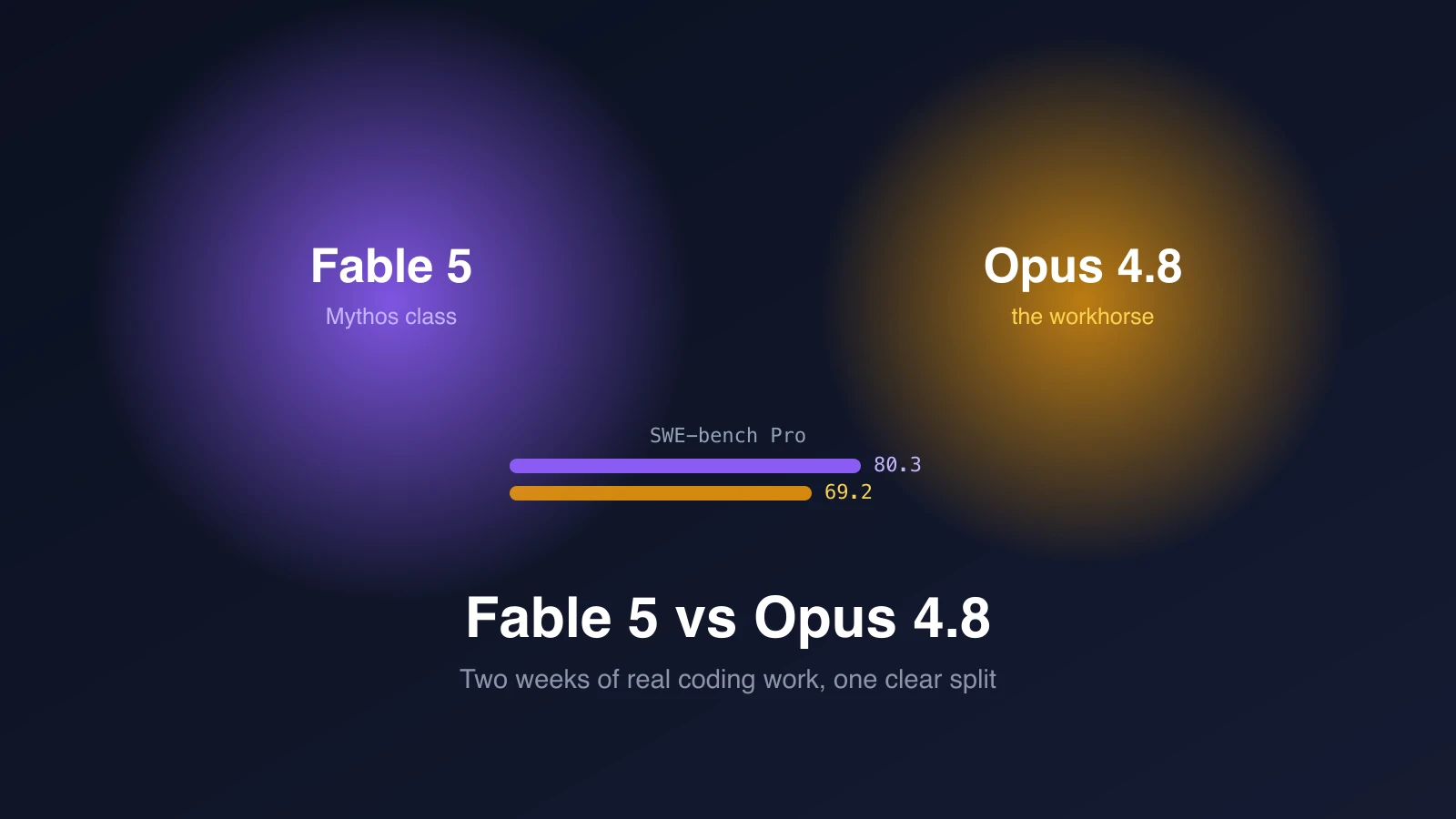
Fable 5 vs Opus 4.8 is the first comparison between adjacent Anthropic tiers where the gap is not a rounding error. We covered the launch-day numbers in our four-model breakdown in June. Since then we have run both models side by side on real work: production features in our own codebase, test-plan generation, and browser-agent runs through our benchmark harness. This post is the two-model verdict, now that Fable 5 has moved out of its included-in-subscriptions window and everyone is paying real money for it.
The one-line version: Fable 5 is the better model by the widest tier-over-tier margin Anthropic has shipped, and Opus 4.8 is still the right default for most production agent workloads. Both things are true, and the split matters more than the leaderboard.
The numbers, head to head
The launch benchmarks, trimmed to just these two:
| Benchmark | Fable 5 | Opus 4.8 |
|---|---|---|
| SWE-bench Verified | 95.0% | 88.6% |
| SWE-bench Pro | 80.3% | 69.2% |
| Terminal-Bench 2.1 | 88.0% | 82.7% |
| FrontierCode Diamond | 29.3% | 13.4% |
| OSWorld-Verified (computer use) | 85.0% | 83.4% |
| GDPval-AA (knowledge work, Elo) | 1932 | 1890 |
Eleven points on SWE-bench Pro and more than double on FrontierCode Diamond is a generational gap on hard coding work. The 1.6-point OSWorld gap is an increment. Keep both of those in view; they describe two different products.
What two weeks of real use looked like
On hard, long-horizon coding tasks, the gap is visible without a benchmark. The tasks where we used to watch Opus 4.8 produce a plausible first attempt and then need two rounds of correction, Fable 5 tends to finish in one pass, with tests. Multi-file refactors stay coherent deeper into the session. Frontend output needs less of the "make it look less AI-built" cleanup pass. This matches what early users reported at launch, and it holds up in daily use.
On routine work, you cannot tell them apart, except on the invoice. Small fixes, glue code, config changes, straightforward test plans: both models do them fine, and Fable 5 does them while burning always-on thinking tokens at a $10/$50 rate card against Opus 4.8's $5/$25. Fable 5 also will not let you disable thinking, so the 2x sticker multiplier runs bigger than 2x in practice on simple tasks.
The silent fallback is real and you should instrument for it. When one of Fable 5's safety classifiers triggers, the request is served by Opus 4.8 instead, with no error. Anthropic puts this under 5% of sessions on average, but the average is not the point: the triggers concentrate in security-adjacent work, and plenty of QA tasks read that way to a classifier (probing logins with bad credentials, testing permission boundaries, revoking keys). In our runs the practical takeaway was simple: some fraction of your "Fable 5" runs are Opus 4.8 runs, so log the serving model where your provider exposes it, and treat quality dips on long agentic sessions as possibly a mid-run model change rather than model variance.
Cost: pay for completed work, not for tokens
The rate card says 2x. The right way to think about it is per completed task.
On hard tasks, Fable 5 finishing in one session what Opus 4.8 needs two or three attempts at makes the expensive model the cheap one, sometimes dramatically so. On routine tasks, the same math runs in reverse: you pay a premium for headroom you never touch. A complex agentic session on Fable 5 can burn 500K to 1M tokens on its own, and launch week produced famous three-figure single days. The model rewards being pointed at the right problems.
For browser automation and testing, the answer is different
Our angle is always the same question: does the new model change what an agent can do in a real browser? The OSWorld gap (1.6 points) says increment, and our harness agrees. On routine test plans, both models pass at the same rate and Opus 4.8 does it at half the token price, so nothing about our April benchmark conclusions flips.
Where Fable 5 earns its rate card in a testing stack is the edges: generating a thorough test plan from a vague spec, diagnosing the failure a cheaper model cannot untangle, and staying coherent through the long multi-page journeys where mid-tier models lose the plot at step 22. That is a small share of steps and a large share of value. We are publishing the full mid-year harness numbers, Fable 5 included, in a separate benchmark post next week.
When to use which
Use Fable 5 when:
- The task is currently failing on Opus 4.8, or takes multiple attempts
- The session is long-horizon: big refactors, multi-hour agent runs, deep debugging
- You are generating plans, architecture, or tests where one strong pass beats three cheap ones
Use Opus 4.8 when:
- The workload is high-volume and routine, and cost per run is the metric
- You need thinking off, or predictable per-request behavior with no fallback ambiguity
- The work is browser-step execution, where the capability gap is smallest
The migration cost between them is near zero (same request shape, swap the model ID), which makes a split deployment the obvious setup: Opus 4.8 as the default lane, Fable 5 as the escalation lane. That is how we run it.
Frequently asked questions
Is Fable 5 worth 2x the price of Opus 4.8?
On hard coding and long agentic work, yes: the completion-rate gap frequently makes it cheaper per finished task. On routine work, no: you pay double the rate plus mandatory thinking tokens for output you could get from Opus 4.8.
Does Fable 5 ever secretly run as Opus 4.8?
Yes, by design. Safety classifier triggers reroute the request to Opus 4.8 silently, under 5% of sessions on average, concentrated in security-adjacent work. Agent builders should log the serving model rather than assume.
Which is better for browser automation?
They are nearly tied on computer-use benchmarks (85.0 vs 83.4 on OSWorld-Verified). For step-by-step browser execution, Opus 4.8 wins on cost. Fable 5 pulls ahead on long, complex journeys and on diagnosing failures.
Test-Lab runs every frontier model through the same production-plan harness, then picks the right model for each step so you do not have to. Run your first AI browser test free.
Related reading:
- Claude Fable 5 vs Opus 4.8 vs GPT-5.5 vs Gemini 3.1 Pro - the full launch-day analysis
- Which LLM is best for browser automation? - the April harness sweep these conclusions build on
- Cursor vs Claude Code vs Codex for E2E testing - why browser work is a different skill than coding