
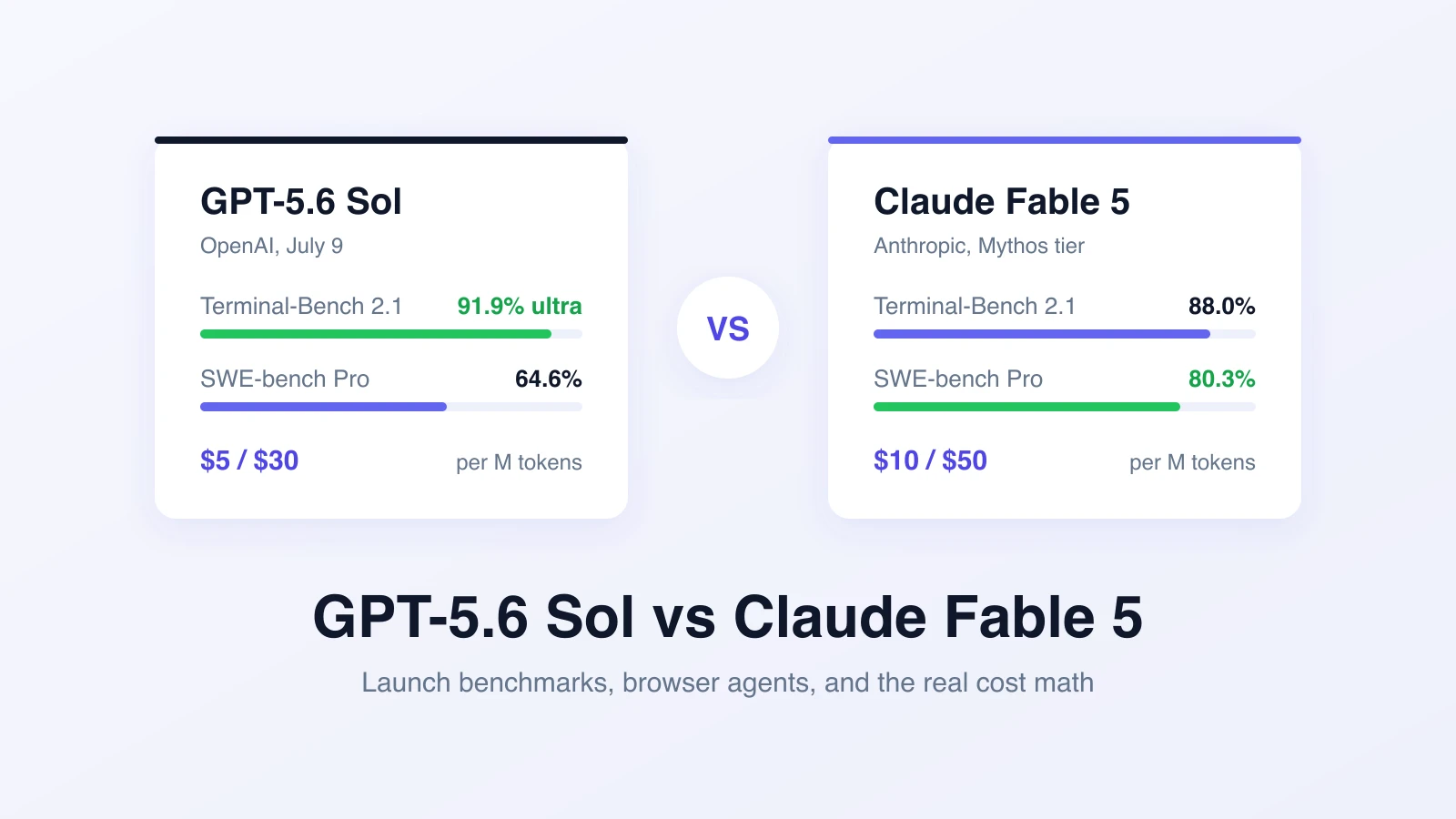
GPT-5.6 vs Fable 5 is the first frontier matchup of the summer where the cheaper model is not conceding the top end. OpenAI shipped the GPT-5.6 family on July 9, after a two-week preview limited to a small partner group: Sol is the flagship, Terra the everyday tier, Luna the fast cheap one. Sol arrives at half Fable 5's rate card, takes the agentic-coding lead on Terminal-Bench, and posts the best published browser-agent numbers we have seen. Fable 5 answers with the score that matters most for real codebases: 80.3% on SWE-bench Pro, which Sol does not approach. This is the head-to-head, with our usual bias toward what each model does in a real browser.
The comparison at a glance
| Dimension | Fable 5 | GPT-5.6 Sol |
|---|---|---|
| SWE-bench Pro | 80.3% | 64.6% (third-party runs) |
| Terminal-Bench 2.1 | 88.0% | 88.8%, 91.9% in ultra mode |
| BrowseComp (browser agents) | not published | 92.2%, best published score |
| Artificial Analysis Intelligence Index (max) | 60 | 59 |
| API price ($/M input / output) | $10 / $50 | $5 / $30 |
| Family | one model | Sol $5/$30, Terra $2.50/$15, Luna $1/$6 |
| Thinking | Always on, cannot be disabled | Effort adjustable, new max effort and ultra mode |
| Model identity | Silent Opus 4.8 fallback, under 5% of sessions | Always the model you asked for |
On the composite Artificial Analysis Intelligence Index the two are a statistical tie, 60 to 59. Everything interesting lives below the composite.
What GPT-5.6 actually is
Three models, one release. Sol is the frontier tier. Terra targets GPT-5.5-level output at roughly half GPT-5.5's cost. Luna is the volume tier at $1 input. Two new controls ship with the family: a max reasoning effort above the existing scale, and an ultra mode that buys Sol its 91.9% Terminal-Bench score. The Responses API adds programmatic tool calling, which lets the model batch tool invocations in code instead of one round-trip per call. Agent builders will feel that one directly: fewer round-trips means faster loops on multi-step work.
The efficiency claim is the headline, though. OpenAI says Sol is 54% more token efficient on coding tasks than GPT-5.5, and the independent numbers back the direction: Artificial Analysis measures Sol at about 15K tokens per Intelligence Index task, using fewer tokens than Opus 4.8 while scoring higher. In agent loops, output tokens are the bill. A model that thinks in fewer of them changes cost-per-run more than any rate card does.
Coding: a split decision, again
The pattern from Fable 5 vs GPT-5.5 repeats one tier up, with the gap narrower.
On Terminal-Bench 2.1, Sol's 88.8% edges Fable 5's 88.0%, and ultra mode pushes it to 91.9%. That is the first time an OpenAI model has topped Fable 5 on a public agentic-coding benchmark, and it is a real jump from GPT-5.5's 83.4%.
On SWE-bench Pro, the benchmark that tests end-to-end fixes in real codebases, the story holds for Anthropic: Fable 5 sits at 80.3% and third-party runs put Sol at 64.6%. That closes six points of GPT-5.5's 22-point deficit and leaves nearly 16. Worth noting what OpenAI published and what it did not: the launch post leads with Terminal-Bench and browser numbers, and no first-party SWE-bench Pro score exists. Vendors show you the benchmarks they win. It is why we keep running our own harness instead of reading launch posts.
So the split: Sol for terminal-style agentic work, bounded tasks, and anything where token burn dominates. Fable 5 when the task is understanding a large codebase and landing a correct change in one pass. That is the same division of labor we found in Fable 5 vs Opus 4.8, now available at half the price.
GPT-5.6 vs Fable 5 for browser automation and E2E testing
This is our corner, and it is where Sol's launch is strongest.
Sol posts 92.2% on BrowseComp and 62.6% on OSWorld 2.0, the best published scores on both. The OSWorld number comes with the detail that matters for testing workloads: it passes Opus 4.8 while producing 85% fewer output tokens. On Agents' Last Exam, a long-horizon agentic eval, Sol scores 13.1 points above Fable 5. OpenAI clearly optimized this release for exactly the loop a browser-testing agent runs: observe page, decide, act, repeat, for hundreds of steps.
Two caveats before anyone reroutes production traffic. First, OpenAI did not publish OSWorld-Verified, the variant our previous comparisons keyed on, so Sol's 62.6% and Fable 5's 85.0% are different benchmarks and do not compare. Benchmark versioning is doing a lot of quiet work in this launch. Second, our April sweep taught us that on routine test plans the whole frontier passes at 100% and the only differentiator is cost, and repeatability across dozens of runs gates production use, not a single pass. GPT-5.6 goes into the same harness as everything else, same plans, no prompt massaging, and we will publish the numbers.
For generated Playwright scripts, GPT-5.5's habit of writing assertion-dense, defensive test code was its quiet advantage over Claude's terser output. Early Sol output looks like it kept the house style. If that survives our script-generation benchmark, the combination of careful assertions and 54% fewer tokens is a strong pitch for the generation lane.
The cost math
The rate card is half of Fable 5's, but the per-task numbers are the better story. Artificial Analysis puts Sol at about $1.04 per coding-agent task, roughly 40% cheaper than Fable 5 at max effort and about 10% cheaper than Opus 4.8. Terra and Luna cut per-task cost by a further 50% and 80%. Cache reads are discounted 90% on both vendors; GPT-5.6 charges 1.25x on cache writes.
Fable 5's counterargument is unchanged from our two-week review: on tasks hard enough that it finishes in one attempt where others need three, the expensive model is the cheap one. That argument now has to clear a higher bar, because the model it is beating costs half as much and finishes more of those tasks than GPT-5.5 did.
The family structure also maps cleanly onto how a testing stack actually routes work: Luna-class models for clicking through steps, Sol or Fable 5 for planning, diagnosis, and the journeys where cheap models lose the plot at step 22. That routing is the whole product argument, and GPT-5.6 just made the cheap lanes cheaper.
When to pick which
Pick GPT-5.6 Sol when:
- Token burn is the bill: long agent sessions, high-volume suites, anything where 85% fewer output tokens compounds.
- The work is terminal-shaped or browser-shaped: its strongest published scores are exactly there.
- You want the dials: reasoning effort under your control, ultra mode when a task earns it, no silent model swaps.
Pick Fable 5 when:
- The task is a real codebase: a 16-point SWE-bench Pro lead is not marketing, it is finished pull requests.
- One strong pass beats three cheap ones: deep debugging, vague specs, architecture.
- Context is the constraint: 1M tokens with no surcharge is still unmatched at the top tier.
At Test-Lab we do not pick one. The harness classifies each step and routes it to the model that earns it. To see that on your own app, run your first AI browser test free.
Frequently asked questions
Is GPT-5.6 better than Claude Fable 5 for coding?
Split decision. Sol leads on Terminal-Bench 2.1 (88.8% base, 91.9% ultra, vs 88.0%) and costs half as much. Fable 5 leads where codebase depth matters: 80.3% vs 64.6% on SWE-bench Pro, per third-party runs. Bounded agentic work favors Sol, hard end-to-end fixes favor Fable 5.
Is GPT-5.6 Sol good for browser automation?
Its launch numbers are the best published: 92.2% on BrowseComp, 62.6% on OSWorld 2.0, and it beats Opus 4.8 on OSWorld while producing 85% fewer output tokens. Production use still hinges on repeatability across many runs, which launch benchmarks do not measure.
What is the difference between GPT-5.6 Sol, Terra, and Luna?
Three tiers of one family. Sol ($5/$30 per million tokens) is the frontier model with ultra mode. Terra ($2.50/$15) targets GPT-5.5-level quality at about half the cost. Luna ($1/$6) is the high-volume tier. All three share the new max reasoning effort and the Responses API's programmatic tool calling.
Test-Lab runs every frontier model through the same production-plan harness, then picks the right model for each step so you do not have to. Run your first AI browser test free.
Related reading:
- Fable 5 vs Opus 4.8: two weeks of real coding work - the intra-Anthropic verdict these conclusions build on
- Claude Fable 5 vs Opus 4.8 vs GPT-5.5 vs Gemini 3.1 Pro - the June launch-day analysis
- Which LLM is best for browser automation? - the April harness sweep and its methodology