
For a decade, browser testing meant one thing: a human writes a script, the script replays exact steps, and the script breaks the moment a button moves. The Model Context Protocol (MCP) is quietly changing that. With tools like Playwright MCP, the "tester" can be an AI agent that looks at the page, decides what to do, and adapts. This post is about what that actually means for a QA team, beyond the demos.
What changes when the tester is an agent
A traditional test is a recording of decisions a human already made. An agent-driven test is a goal plus the freedom to figure out the steps. You tell it "sign up, create a project, invite a teammate, confirm they appear," and the agent reads the page through MCP's accessibility snapshots, finds the right elements by role and label, and works toward the goal.
Two things fall away:
- Brittle selectors. The agent targets "the Invite button," not
div.sidebar > button:nth-child(3). A redesign that would have broken 40 scripts often just works. - The recording step. You describe intent in plain language instead of clicking through a recorder and editing the output.
This is a real shift in where the effort goes: away from maintaining steps, toward describing intent and judging results.
Where MCP genuinely helps QA
Not everything benefits equally. The honest wins:
- Exploratory testing. Point an agent at a new feature and let it probe. It finds the dead ends and broken states a fixed script would never visit.
- Self-healing flows. When the UI shifts, an agent re-derives the path instead of failing. This is the single biggest maintenance saver.
- Triage and reproduction. "Reproduce this bug report" is a task an agent can attempt directly, capturing what it saw along the way.
These map cleanly to MCP's strengths: live perception, reasoning, and adaptation at every step.
Where it breaks
It is not magic, and pretending otherwise burns teams. The real limits:
- Determinism. The same prompt can take two different valid paths. For a regression suite that must assert the exact same thing every night, you want tighter control than a free-roaming agent gives you.
- Context limits. MCP streams each page snapshot into the model's context. Long runs overflow it and the agent starts to drift. (This is the core of our Playwright MCP vs CLI comparison.)
- Cost. Tokens add up. A 100-step agent run is not free the way replaying a script is.
- Security. An MCP browser server is explicitly not a security boundary. Running one unattended without isolation is how a testing tool becomes an incident.
The teams that succeed treat MCP-driven testing as a powerful new tool in the kit, not a replacement for every deterministic check they already have.
The thing nobody tells you: an agent that can test is not a test suite
This is the gap that surprises people. Getting an agent to drive a browser is the easy 20%. The other 80% is everything around it:
- Running the same checks reliably, on a schedule, across environments (staging, prod, a PR preview).
- Capturing evidence every time: traces, screenshots, video, console, network. When a run fails at 3am, you need to see why without re-running it.
- A history a team can actually look at: what passed, what flaked, what regressed.
- Cost and concurrency control so an agent fleet does not surprise you.
None of that comes from the MCP server itself. MCP gives you the hands. You still have to build the body.
How to adopt MCP-based testing without the chaos
Two sane paths:
- Build it yourself. Run Playwright MCP (our setup guide covers it), wire it into CI, and assemble the reliability and evidence layer. Real engineering, full control.
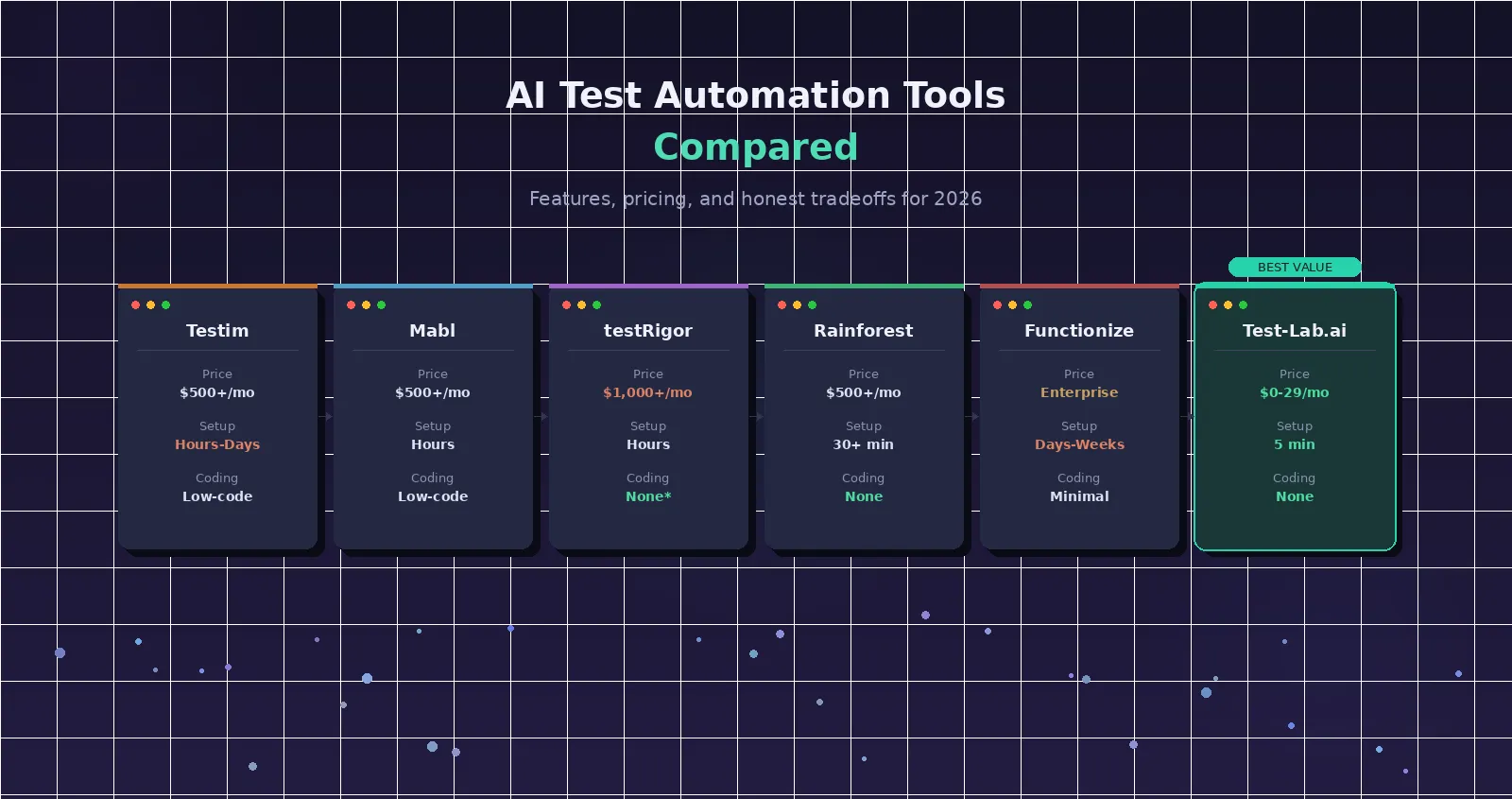
- Use a platform that already did the 80%. This is why Test-Lab.ai exists. You describe tests in plain English, AI agents run them like a real user with the same structured approach MCP uses, and we own execution reliability, evidence capture, scheduling, and environments. Because we are agent-native, your own AI tools can trigger and read those runs over MCP, so you get the agent workflow without operating the plumbing.
Most QA teams do not want to become MCP infrastructure operators. They want the outcome: dependable coverage that does not break every release.
The bottom line
MCP is a genuine step change in how browser testing works. It kills brittle selectors and makes self-healing real. It does not kill the need for reliability, evidence, and a place to see results, and it adds new failure modes around determinism, context, and security. Adopt it for exploration and self-healing, keep deterministic checks where you need them, and decide early whether you are building the surrounding platform or buying it.
Want agent-driven QA without operating the infrastructure? Try Test-Lab free and run your first test in minutes.
Related reading:
- What is Playwright MCP? – the primitive behind agent-driven testing
- How to set up Playwright MCP – connect it to Claude, Cursor, and VS Code
- Playwright MCP vs Playwright CLI – the determinism and cost tradeoff
- The best AI QA tools in 2026 – an honest, ranked comparison