
Your last deploy broke checkout. You found out because a user tweeted about it. The fix took 20 minutes, but the damage took longer to undo: refund requests, a support thread, and a Hacker News comment about your product being "half-baked."
This happens to startups constantly. Not because founders don't care about quality, but because testing feels like a luxury when you're racing to find product-market fit with three engineers and a burn rate that won't wait.
Here's the thing: skipping tests doesn't make you faster. It makes you faster at shipping bugs.
The startup testing gap
The numbers paint a clear picture. Developers spend only about 12% of their time on testing. The rest goes to writing features, maintaining existing code, and dealing with fires. For startup teams, that 12% is often closer to zero because every hour feels like it needs to go toward the next feature.
The result is predictable. 72% of organizations have experienced P1 incidents caused by code that shipped without proper testing. At a startup, a P1 isn't just an incident. It's a potential churn event, a lost deal, a reason investors ask hard questions in your next board meeting.
And the cost math is brutal. A bug caught during development costs roughly $10 to fix. The same bug caught in production costs $100 to $10,000, depending on severity. That's not a typo. The IBM "1-10-100 rule" has been validated repeatedly across the industry, and it hits startups hardest because they can't absorb the cost of rolling back a release, comping angry customers, and pulling engineers off feature work to fight fires. A single bad deploy at a pre-Series A company can wipe out a full week of revenue and tank the trust you've been building with early adopters.
Why startups skip testing (and why those reasons don't hold up)
Four arguments come up over and over. All of them sound reasonable. None of them survive contact with reality.
"We don't have time." You don't have time to not test. Every production bug that reaches users creates an interrupt. An engineer drops what they're doing, triages, fixes, deploys, and then tries to remember where they were. That context switch costs 20 to 30 minutes minimum, often more. Two production bugs a week is an engineer losing half a day, every week, forever. Testing takes less time than that.
"We'll add tests later." No you won't. Every team says this. Almost none follow through. The codebase gets bigger. The surface area grows. The "later" that was supposed to be manageable becomes a project that nobody wants to own. The prototype becomes the product, and suddenly you have a system nobody fully understands with no safety net.
"Our devs can test their own code." They can't. Not effectively. The person who wrote the code has the same blind spots as the code itself. They'll test the happy path because that's the path they built for. The edge cases that break in production are the ones the developer didn't think of, which is exactly why they're not in the code.
"We can't afford a QA team." You don't need one. That's the point of this post. A dedicated QA hire costs $80,000 to $120,000 per year. Automated testing that actually works for startup workflows costs a fraction of that and runs 24/7 without calling in sick.
What "automated testing" actually looks like for a startup
Let's be specific. When people say "automated testing," they usually mean one of three things, and the differences matter.
Unit tests verify that individual functions work correctly. They're fast, cheap, and your engineers should write them. But they don't catch the bugs that hurt you most. A unit test can confirm that your pricing function calculates correctly while missing the fact that the checkout button doesn't work on Safari.
Integration tests verify that systems talk to each other correctly. Your API returns the right data, your database queries work, your third-party integrations don't fail silently. Important, but still not the whole picture.
End-to-end (E2E) tests verify that your app works the way a user actually uses it. Open the browser, click through the flow, verify the result. This is where most startups have zero coverage, and it's where the most painful bugs live. The checkout flow that breaks after a CSS change. The signup form that silently fails on mobile. The dashboard that shows stale data after a deploy.
E2E testing is what this post is really about. It's the layer that catches the bugs your users would find, before they find them.
The traditional E2E trap
You could set up Cypress or Playwright. Both are excellent frameworks. The State of JS 2025 survey shows Playwright at 91% developer satisfaction and 33 million weekly npm downloads. It's good software.
But here's what actually happens when a three-person startup tries to implement Playwright:
Week 1: One engineer spends two days setting up the test framework, configuring the CI pipeline, and writing the first three tests. The tests cover login, the main dashboard, and one API flow.
Week 2-4: The team ships new features. Nobody writes new tests because there's no time. The three existing tests start failing because the UI changed. The engineer who wrote them fixes two of them. The third stays broken because the fix is non-trivial and there are higher-priority things to do.
Month 2: The test suite has five tests. Two are broken. The CI pipeline is configured to not block deploys when tests fail, because blocking on broken tests was slowing everyone down. The tests run on every push, fail, and nobody looks at the results. The team has effectively invested 20+ hours in a testing setup that provides zero value.
This isn't a strawman. It's the most common outcome. Traditional E2E automation requires ongoing maintenance that consumes up to 80% of the testing effort. For a startup team that barely has time to write features, that maintenance burden kills the initiative within weeks.
A different approach: test in plain English
What if setting up a test took two minutes instead of two days? What if the test didn't break when you changed a CSS class? What if anyone on the team could write one, not just the engineers?
That's the idea behind AI-powered E2E testing. Instead of writing selector-based scripts, you describe what should work:
"Go to our signup page, create an account with a test email, verify the welcome screen appears, then navigate to settings and confirm the profile shows the correct email."
An AI agent opens a real browser, follows those instructions like a human would, and reports back with screenshots and results. No selectors to break. No page objects to maintain. No healing logic needed because nothing was brittle in the first place.
This changes the math for startups in three ways.
Setup time drops from days to minutes. There's no framework to configure, no test infrastructure to build, no CI pipeline to wrangle. Write a test description, run it, get results.
Maintenance goes to near zero. When your UI changes (and it will, constantly, because you're a startup), the AI agent adapts. It finds the button by understanding what it is, not by matching a CSS selector that stopped existing three deploys ago. Your tests keep passing through redesigns, refactors, and component library swaps.
Anyone on the team can write tests. Your cofounder who handles product? They can write a test. Your first customer support hire? They can write a test. They know the flows that matter because they're the ones who hear about it when those flows break.
What to test first
You don't need 200 tests. You need five good ones.
Start with the flows that would hurt worst if they broke. For most startups, that's:
Signup and onboarding. If new users can't create an account, nothing else matters. Test the whole flow: landing page to signup form to email verification to first meaningful screen. Cover both desktop and mobile.
The core value action. Whatever your product does, test the primary thing users came for. If you're a project management tool, test creating a project. If you're an e-commerce platform, test adding to cart and checking out. If you're a SaaS dashboard, test loading and displaying data.
Payments. If you take money, test the payment flow on every deploy. A broken checkout is lost revenue. This is not the place to find bugs from user reports.
Authentication edge cases. Login, logout, password reset, session expiry. These flows touch security and user trust. They break more often than you'd expect because they interact with session state, cookies, and redirects in complex ways.
The flow that broke last. Whatever caused your most recent production incident, write a test for it. This is your regression safety net. The same bug shouldn't hit you twice.
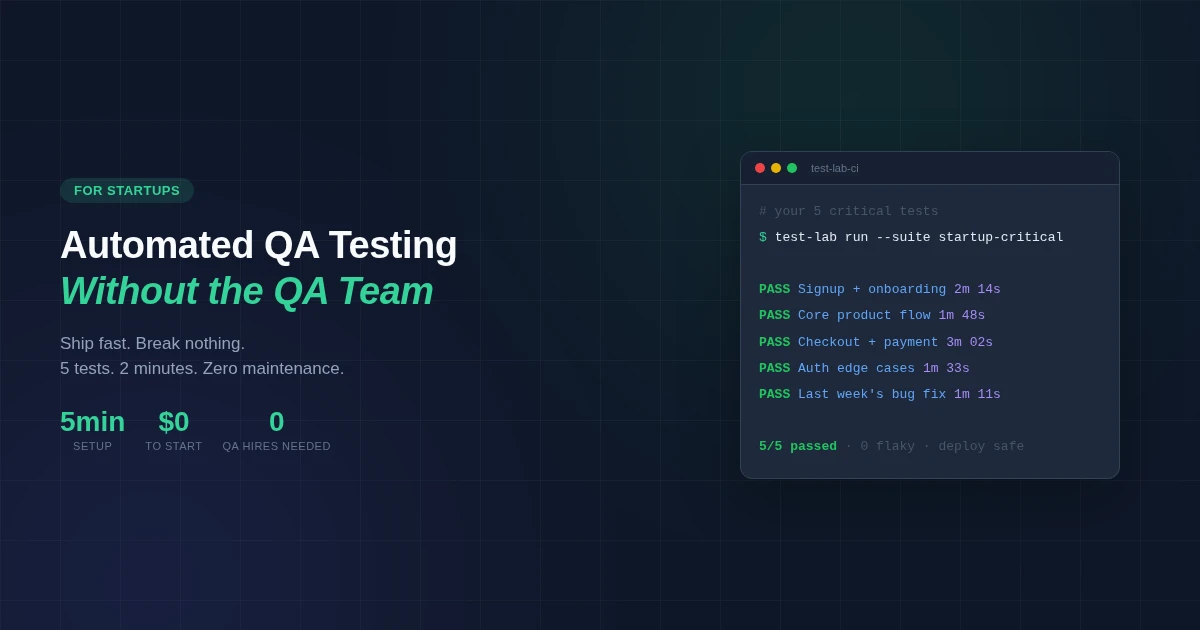
Five tests. Each one is a few sentences of plain English. Total time investment: maybe an hour. But those five tests, running on a schedule or triggered by your CI pipeline, catch the vast majority of the bugs that would otherwise reach your users.
Fitting testing into a startup workflow
The key is making testing invisible. It should happen automatically, report only when something breaks, and never block your team from shipping.
Here's what that looks like in practice:
On every deploy: Run your five critical tests. If they pass, the deploy goes through. If one fails, you know immediately and can decide whether to roll back or ship anyway. This takes 5-15 minutes and needs one line in your CI config.
Nightly: Run a broader set of tests if you've built them up over time. Catch the slower-burning issues: pages that load but show wrong data, flows that work on Chrome but break on Firefox, forms that accept invalid input.
After incidents: Every production bug gets a test. Not a unit test buried in the codebase. An E2E test that verifies the user-facing behavior. This is how your test suite grows organically without anyone dedicating a sprint to "testing infrastructure."
The total cost is a few dollars per day in test credits and zero engineering hours on maintenance. Compare that to the cost of one production incident per week, and the ROI is obvious.
The testing investment that pays back fastest
Every dollar spent on testing saves $5 to $10 in avoided bug costs. A basic automated test suite reaches positive ROI within three to six months. Production bugs decrease 60-80% by month 12.
For startups, the payback is even faster because the alternative (no testing) is so expensive. You're not comparing "testing vs. better testing." You're comparing "testing vs. hoping nothing breaks." Hope doesn't scale.
The companies that ship fastest aren't the ones that skip testing. They're the ones that found ways to test without it feeling like work. Automated, invisible, and out of the way until something actually breaks.
Getting started without the overhead
Here's the minimum viable testing setup for a startup:
- Pick your five critical flows
- Write each one as a sentence or two describing what should happen
- Run them once to verify they pass
- Add them to your CI pipeline or set up a schedule
- Forget about them until something fails
You can run your first test on Test-Lab in under two minutes. No signup for the first five demo runs. Describe what your app should do, watch the AI agent verify it in a real browser, and see the results with screenshots at every step.
If it catches something, you just saved yourself a user-facing bug. If everything passes, you just bought yourself confidence that your last deploy didn't break anything.
Either way, it took two minutes. That's a trade worth making.
If you want a deeper look at the no-code testing approach, we wrote about how it works and what the tradeoffs are. And if you're evaluating tools, our honest comparison of AI testing platforms covers what each option actually costs and who it's built for.
Stop finding bugs from user complaints. Try Test-Lab and get your first five E2E tests running today. Plain English in, real browser testing out.