
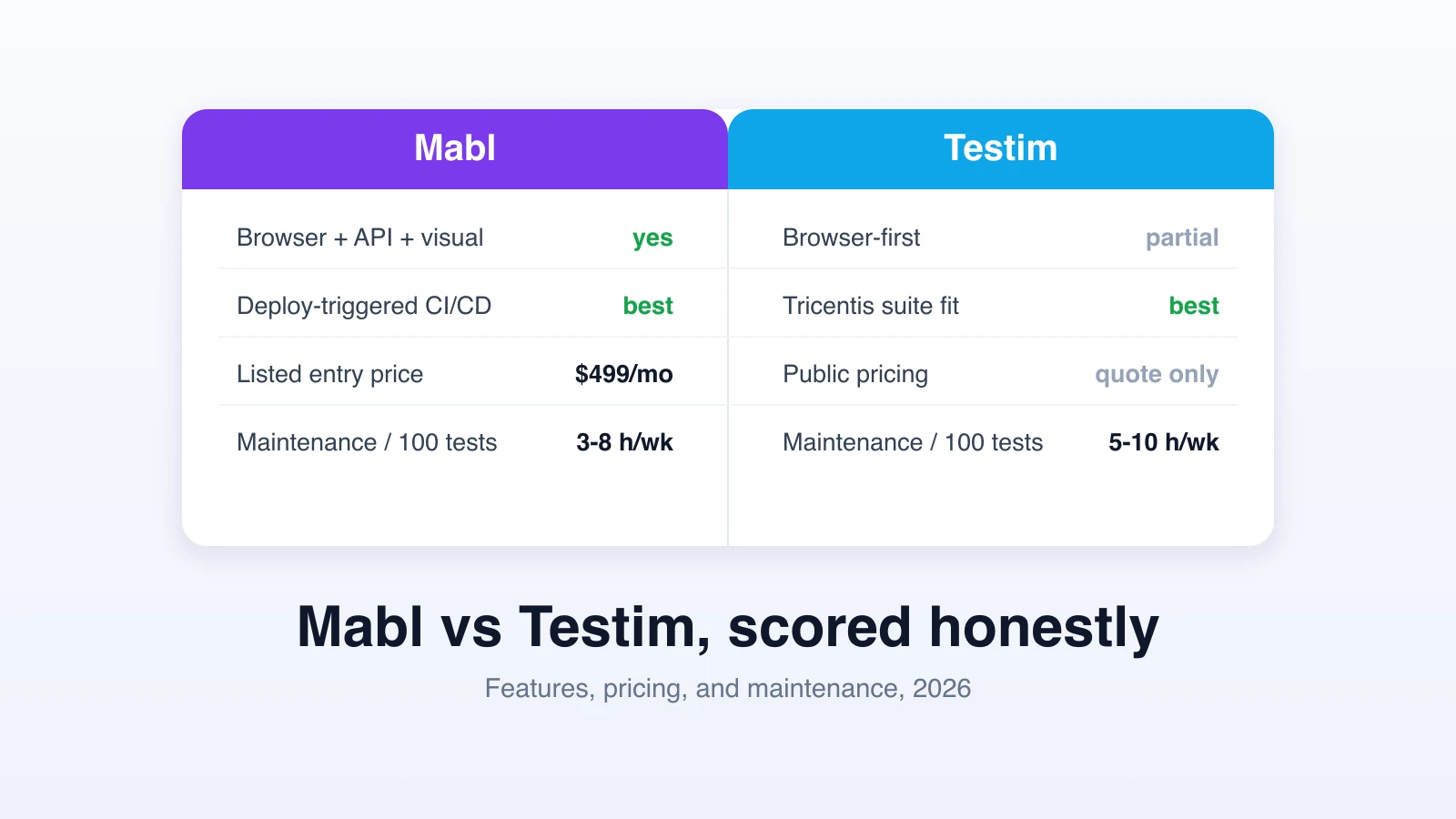
Mabl vs Testim is one of the most common shortlist matchups in test automation, and the comparison is closer than either vendor admits. Both are recorder-based platforms with AI-assisted element location. Both self-heal minor UI changes. Both price for the enterprise. The differences that actually decide the choice are narrower: what else ships in the box, how testing plugs into your pipeline, and how you buy.
We build a competing product at Test-Lab, so read this knowing where we sit. We will keep the scoring honest, because most teams evaluating these two are enterprise teams we are not trying to win anyway.
The short answer
Pick Mabl if you want one platform that covers browser, API, and visual testing with the best deployment-triggered CI integration in the recorder category. Pick Testim if you are already inside the Tricentis suite (qTest, NeoLoad) or you test Salesforce heavily. If you are a smaller team without a dedicated QA function, both are probably more platform than you need, and the last section is for you.
What they have in common
It is worth being clear about how similar these products are before listing differences.
Both create tests with a visual recorder: you click through a flow, the platform captures steps, you add assertions. Both store multiple locator strategies per element (selectors, text, position) and fall back between them when the UI changes, which is what "self-healing" means in this product category. Both handle small changes well and larger redesigns badly, because a fallback locator cannot survive a restructured component tree. And both are sold to teams with QA engineers who will live in the platform daily.
The realistic maintenance budget is similar too: teams we have talked to put a 100-test suite at roughly 3 to 8 hours a week on Mabl and 5 to 10 on Testim, most of it repairing steps after UI changes.
Where Mabl is stronger
- Unified test types: browser, API, and visual regression tests live in one platform, and API steps can be mixed into browser flows. Testim is browser-first, with API testing a weaker add-on.
- Deployment-aware CI/CD: Mabl treats deployments as first-class events. Push to staging, and the test plan tied to that environment runs automatically, with results gated back into GitHub Actions, Jenkins, CircleCI, GitLab, or Azure DevOps. This is the best pipeline story in the recorder category.
- Visual change detection: pixel-level comparison ships as a core feature and catches layout drift that functional assertions miss.
- Buying experience: Mabl still publishes entry pricing (Starter around $499 a month, Professional around $1,199 when last listed), so you can budget before the sales call. Enterprise tiers are custom.
Where Testim is stronger
- The Tricentis suite: since the acquisition, Testim connects into qTest for test management, NeoLoad for load testing, and the rest of the Tricentis stack. If your organization already runs on those, Testim slots in with less glue.
- Salesforce testing: Testim has dedicated Salesforce support that goes deeper than a generic recorder can, which matters to exactly the teams that need it.
- Locator maturity: Testim's smart locators have been in production for years and behave predictably. Teams that know the product can usually predict what a UI change will and will not break.
- Enterprise process fit: role-based access, audit trails, and the sales-led rollout enterprises expect. Note that this cuts both ways: there is no meaningful self-serve tier anymore, and public pricing is gone. Budget for an enterprise quote and the sales cycle that comes with it.
Pricing reality
| Mabl | Testim | |
|---|---|---|
| Entry price | ~$499/mo (Starter, when listed) | Enterprise quote only |
| Mid tier | ~$1,199/mo (Professional) | Custom |
| Free option | 14-day trial | Limited community tier |
| Model | Subscription: features + execution volume | Per-seat plus usage |
Both land in the $6,000 to $15,000+ per year range for a real deployment before you count engineer hours. The bigger line item is maintenance: at a loaded engineering cost, 5 hours a week of test repair is another $15,000 to $20,000 a year. We ran the full cost math, including that hidden line, in how much AI testing actually costs.
The decision rubric
Choose Mabl when:
- You want browser, API, and visual tests in one tool
- Deployment-triggered testing matters to your pipeline
- You want at least indicative pricing before engaging sales
Choose Testim when:
- Tricentis tools are already in the building
- Salesforce flows are a big share of what you test
- Procurement prefers an enterprise contract with a suite vendor
When the answer is neither
Both platforms assume a team that records tests, maintains locators, and staffs a QA function. A newer generation of tools skips the recorder entirely: you describe the flow in plain English, and an AI agent executes it in a real browser, finding elements by meaning instead of stored locators. When the UI changes, there is nothing to heal, because there were never selectors to break.
That approach trades raw execution speed for near-zero maintenance and a much lower starting price, which is the right trade for most teams under a few hundred tests. We compared all three models directly in Test-Lab vs Testim vs Mabl, and the per-platform breakdowns live at /compare/mabl and /compare/testim.
Frequently asked questions
Is Mabl better than Testim?
For most teams starting fresh, Mabl has the edge: broader test types, better CI/CD integration, and clearer pricing. Testim wins inside Tricentis shops and for Salesforce-heavy testing. Neither is better in the abstract; the deciding factors are your existing stack and who will maintain the tests.
How much does Testim cost?
Testim no longer publishes pricing. Expect a sales-led enterprise quote shaped by seats and usage, with historical entry points reported around $450 a month. There is a limited community tier for evaluation.
Do Mabl and Testim require coding?
Both are low-code rather than no-code. Routine flows work in the recorder, but dynamic content, custom waits, and edge cases end up in JavaScript snippets on both platforms, so plan for at least one team member comfortable writing them.
Want the no-recorder alternative? Try Test-Lab free: describe the flow in plain English, and an AI agent runs it in a real browser with nothing to record or maintain.
Related reading:
- Test-Lab vs Testim vs Mabl - the three-way comparison with the agent-based option included
- How much does AI testing actually cost in 2026? - real listed prices across ten tools
- Self-healing tests - why locator fallback is not the same as no maintenance
- The best AI QA tools in 2026 - an honest, ranked comparison