
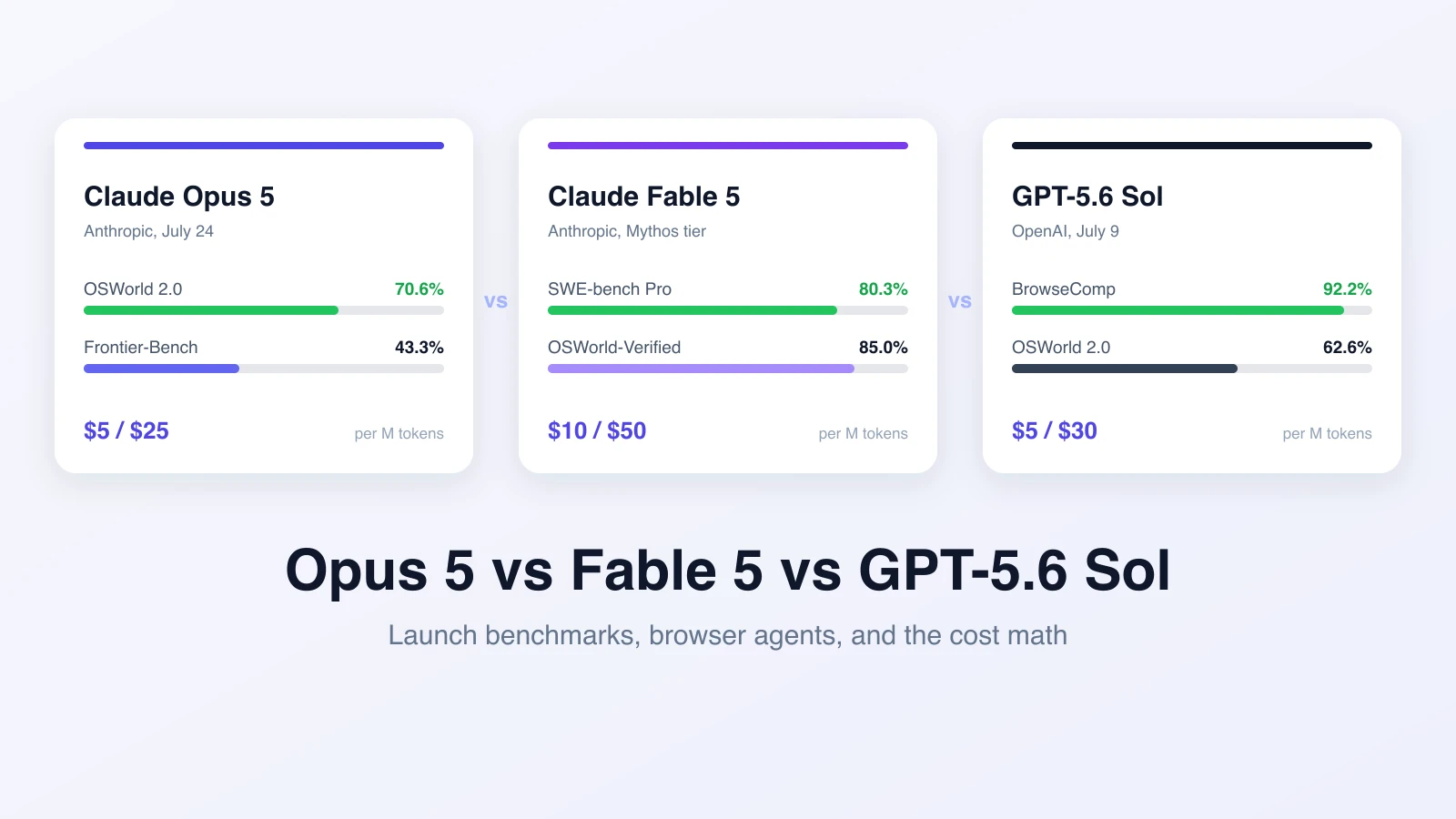
Anthropic shipped Claude Opus 5 on July 24, and it resets the flagship question for browser testing. Opus 5 lands at $5 / $25 per million tokens, half of Fable 5's rate card, and Anthropic leads the launch with computer use: on OSWorld 2.0 it clears Fable 5's best result at just over a third of the cost. That puts three frontier models in the browser-agent conversation at once, Opus 5, Fable 5, and GPT-5.6 Sol, and for the first time the cheapest of the three is not conceding the top end. Here is how they line up for driving a real browser, with our usual bias toward what a model does across hundreds of steps, not what a launch chart says.
The comparison at a glance
| Dimension | Opus 5 | Fable 5 | GPT-5.6 Sol |
|---|---|---|---|
| OSWorld 2.0 (computer use) | ~70.6% (third-party) | see note | 62.6% |
| BrowseComp (browser agents) | not published | not published | 92.2% |
| Frontier-Bench v0.1 (coding) | 43.3% | 33.7% | not published |
| ARC-AGI 3 (novel problems) | 30.2% | not published | 7.8% |
| API price ($/M input / output) | $5 / $25 | $10 / $50 | $5 / $30 |
| Context window | 1M tokens | 1M tokens | family, effort-tiered |
| Thinking control | effort low / medium / high | always on | effort plus ultra mode |
Opus 4.8, the model Opus 5 replaces, is the baseline hiding under those numbers: it sat at 18.7% on Frontier-Bench v0.1 and 1.5% on ARC-AGI 3 at the same $5 / $25 price. The generational jump at an unchanged price is the story Anthropic is selling, and on coding and novel-problem tasks the gap is real.
What Opus 5 changes
Opus 5 is Anthropic's bid to bring near-Fable capability down to the Opus tier's price. It more than doubles Opus 4.8 on Frontier-Bench v0.1 (43.3% against 18.7%), lands within 0.5% of Fable 5's peak on CursorBench 3.2 at half the cost per task, and scores roughly three times the next-best model on ARC-AGI 3. It keeps the 1M-token context window and adds a per-request effort control, so you can dial reasoning up for a hard journey and down for routine clicks. For agentic work the pitch is simple: frontier-class output at a price that used to buy you the previous generation.
Computer use and browsing: the numbers that matter for testing
This is our corner, and it is where the launch is loudest and messiest.
On OSWorld 2.0, the computer-use benchmark that best resembles a browser agent's loop, third-party runs put Opus 5 around 70.6% and GPT-5.6 Sol's own published score is 62.6%. Anthropic's framing is relative rather than absolute: Opus 5 clears Fable 5's best OSWorld 2.0 result at just over a third of the cost, and Anthropic publishes those charts as images, so the 70.6% is a third-party read, not a first-party figure. Sol still owns the browsing benchmark outright, at 92.2% on BrowseComp, the best published score anywhere.
One caveat carries the whole section: benchmark versioning. Fable 5's widely cited 85.0% is on OSWorld-Verified, a different benchmark than OSWorld 2.0, so it does not line up against the 2.0 numbers above, and BrowseComp only has a score from one vendor. Reading a winner across three launch posts means reading across three different rulers. It is the exact reason we run our own harness instead of stacking vendor charts.
The cost math
The rate card is the easy part: Opus 5 at $5 / $25 undercuts Fable 5's $10 / $50 by half and matches Opus 4.8, while Sol sits at $5 / $30. Per-task cost is the real number, and it turns on token efficiency. Sol passed Opus 4.8 on OSWorld while producing 85% fewer output tokens, and Opus 5 clears Fable 5's OSWorld result at about a third of the cost. In an agent loop that observes a page, decides, and acts for hundreds of steps, output tokens are the bill, so how few tokens a model thinks in moves cost-per-run more than the sticker price does.
Why we do not call it from launch charts
Two things keep these numbers a starting point rather than a verdict for browser testing.
First, the versioning problem above: when the headline benchmark ships in two incompatible variants in the same month, a single percentage is doing less work than it looks like. Second, and bigger, OSWorld and BrowseComp measure one agent completing one task once. A test suite needs the same plan to pass repeatably across dozens of runs, on a real production surface, with cleanup verified and cost bounded, not a single lucky pass. On routine plans our April sweep found the whole frontier passes at essentially 100%, and the only separators are repeatability and cost.
That is what our harness measures: the same plans, the same production surface, serial execution, per-run cleanup verification, default configuration for every model, and no prompt massaging. Opus 5 goes into it now, alongside Fable 5, GPT-5.6 Sol, and the incumbents, on the same plans as our mid-year sweep. We publish the pass rates, durations, and cost-per-run once the runs are in, the same way we always have, and not a number before then.
When to pick which, for browser work
Pick Opus 5 when you want frontier-tier reasoning at the Opus price: strong computer-use pedigree, near-Fable capability, half of Fable 5's cost, and effort you can turn down for routine steps.
Pick Fable 5 when the hard part is a real codebase, not the click path: it leads on SWE-bench Pro at 80.3% and is the model to beat for generated Playwright scripts and one-strong-pass diagnosis, as we found in Fable 5 vs Opus 4.8.
Pick GPT-5.6 Sol when the loop is long and token burn is the bill: the best published browsing score, strong terminal-shaped work, and effort dials with an ultra mode, detailed in our Sol head-to-head.
At Test-Lab we do not pick one. The harness classifies each step and routes it to the model that earns it, so a cheap model clicks through the setup and a frontier model handles the journey where cheap models lose the plot at step 22.
Frequently asked questions
Is Opus 5 better than GPT-5.6 Sol for browser automation?
On OSWorld 2.0 the computer-use edge goes to Opus 5, with third-party runs near 70.6% against Sol's published 62.6%, while Sol leads browsing at 92.2% on BrowseComp. Both are launch numbers on partly incompatible benchmarks, and neither measures repeatability across many runs, which is what actually gates production use.
How much does Claude Opus 5 cost compared to Fable 5?
Opus 5 is $5 per million input tokens and $25 per million output, exactly half of Fable 5's $10 / $50 and the same price as the Opus 4.8 it replaces. Per-task cost depends on token efficiency, where Opus 5 and Sol both do well.
Which model should I use for E2E tests today?
Route per step rather than betting the suite on one model: a cheap tier for mechanical steps, a frontier model for planning and the fragile journeys. Our harness sweep with Opus 5 added is running now, and we will publish the pass-rate and cost-per-run numbers on real production plans when it finishes.
Test-Lab runs every frontier model through the same production-plan harness, then routes each step to the model that earns it so you do not have to. Run your first AI browser test free.
Related reading:
- The 2026 mid-year browser agent benchmark - the harness sweep Opus 5 is joining next
- Fable 5 vs GPT-5.6 Sol - the launch head-to-head on Sol's browser numbers
- Which LLM is best for browser automation? - the April sweep and the methodology behind it
- Fable 5 vs Opus 4.8 - the intra-Anthropic split these picks build on