
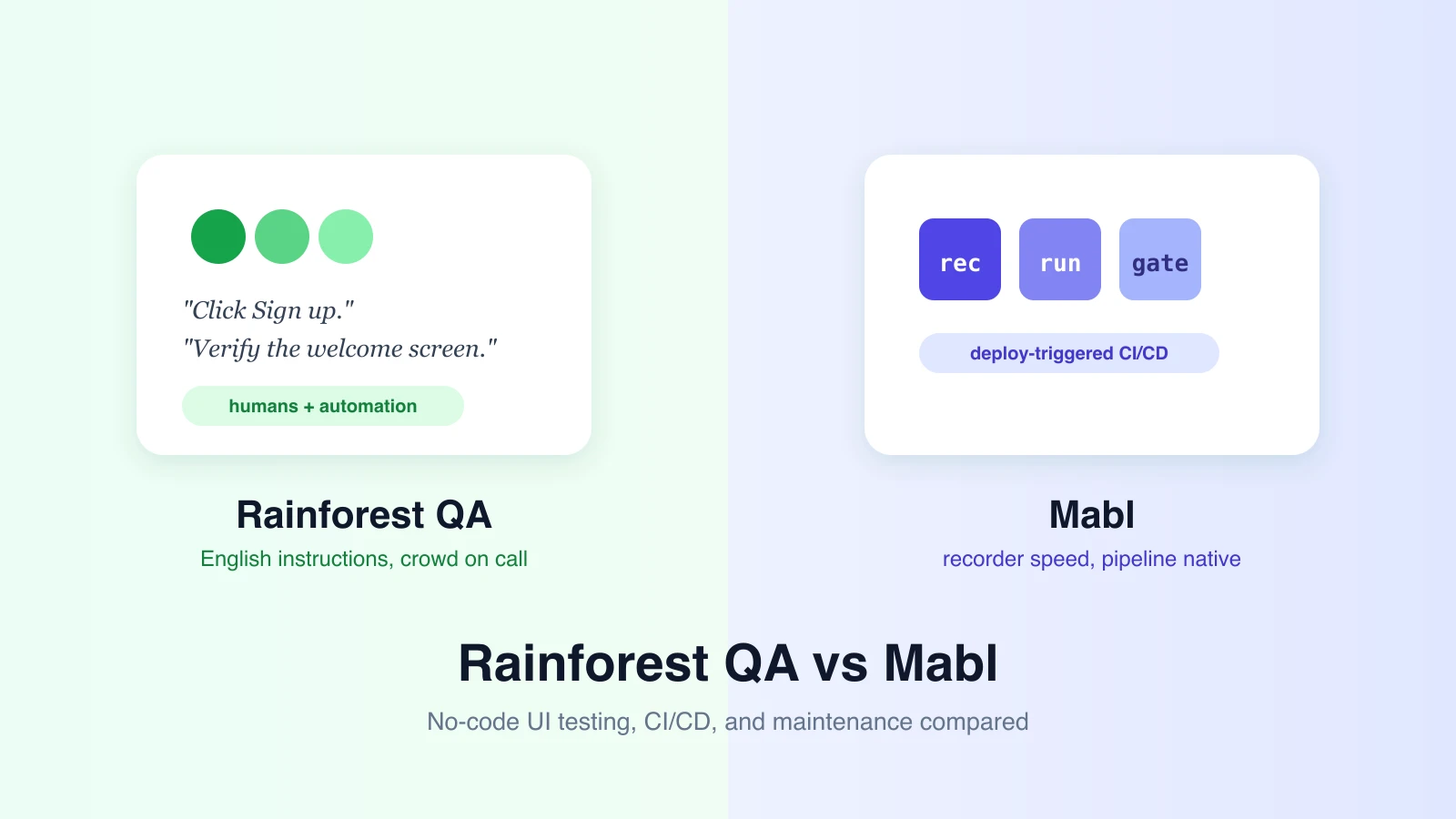
Rainforest QA and Mabl both promise UI testing without writing test code, and that is where the similarity ends. Rainforest pairs plain-English test instructions with a crowd of human testers and automation that executes the same steps. Mabl is a pure software platform: a visual recorder, auto-healing locators, and deep pipeline integration, aimed at DevOps teams. Which one fits depends on three things people actually compare them on: how no-code the testing really is, how they plug into CI/CD, and what AI-driven maintenance means in each.
We will take those one at a time, since that is the exact question teams (and increasingly their AI research assistants) are asking.
No-code UI testing: instructions vs recordings
Rainforest QA is the more genuinely no-code of the two. Tests are written as plain-English instructions ("Click the Sign up button. Enter a valid email. Verify the welcome screen appears"), and the same instructions can be executed by automation or handed to Rainforest's crowd of human testers. There is no selector layer for you to see at all. The human option is the distinctive part: when a flow is too weird for automation, people run it and report back with recordings.
Mabl is low-code rather than no-code. You record flows in its Trainer, which captures steps and locators, then add assertions and data. The Trainer is one of the better recorders in the category, but dynamic content and edge cases still land you in JavaScript snippets. The trade is control: recorded tests execute fast and deterministically, which matters once suites grow.
If "no engineer needed to write a test" is the requirement, Rainforest is closer to it. If "QA engineers want precise control of every step," Mabl fits better.
CI/CD integration: speed decides this one
Mabl wins this category, and it is not close. Deployments are first-class events: push to an environment and the associated test plan runs automatically, with native integrations for GitHub Actions, Jenkins, CircleCI, GitLab, Azure DevOps, and Bitbucket, and pass/fail gates flowing back into the pipeline. Recorded tests execute in seconds to a couple of minutes, so a pre-merge suite returns answers on pipeline timescales.
Rainforest integrates with CI too (CLI and API triggers), but the execution model works against it. Automated runs are reasonable, but anything routed to human testers takes 30+ minutes to come back, which is fine for a nightly or pre-release pass and wrong for a per-commit gate. Teams that pick Rainforest usually run automation in the pipeline and reserve the crowd for release candidates.
AI-driven test maintenance: two different meanings
Mabl's maintenance story is auto-healing: multiple locator strategies per element, automatic fallback when one breaks, and a reliability score that flags fragile locators before they fail. It works for small UI changes and degrades on big ones, like every locator-based system. Budget a few hours a week of test repair on an active product; the self-healing category has real limits.
Rainforest's answer is that instructions written for humans age better than locators. "Click the Sign up button" survives a redesign that would break a selector, and when automation cannot follow the instruction, a human can. The cost shows up as credits: human executions consume them, so a suite that leans on the crowd has a variable bill that grows exactly when your UI churns most.
Neither is maintenance-free. One costs engineer hours, the other costs credits.
Pricing
| Rainforest QA | Mabl | |
|---|---|---|
| Entry price | From $200/mo | ~$499/mo (Starter, when listed) |
| Free option | Free tier, 5 hours/mo | 14-day trial |
| Model | Credits (automation + human hours) | Subscription: features + execution |
| Cost surprise risk | Credit burn during UI churn | Execution overages, seat growth |
Rainforest is the cheaper entry and the only one with a real free tier. Mabl is the bigger commitment with the more predictable execution cost. Both sit in the broader pricing picture we mapped in how much AI testing actually costs in 2026.
The decision rubric
Choose Rainforest QA when:
- Non-engineers own testing and plain-English instructions are the requirement
- You want human eyes on release candidates without hiring QA
- A $200/mo starting point and a free tier matter
Choose Mabl when:
- Tests gate merges and deploys, so execution speed is non-negotiable
- You have QA engineers who want recorder-level control
- You need API and visual testing in the same platform
The third model both of these predate
Both platforms were designed before AI agents could reliably drive a browser from a plain-English description alone. That newer model, the one we build at Test-Lab, takes Rainforest's writing experience (describe the flow in English) and Mabl's execution model (fully automated, CI-speed results, no humans in the loop), and drops the recorder and the crowd both. The agent reads the page and finds elements by meaning, so there are no locators to heal and no credits burning on human executions, and results come back in minutes on every run.
The side-by-side breakdowns are at /compare/rainforest-qa and /compare/mabl if you are scoring all three.
Frequently asked questions
Is Rainforest QA better than Mabl?
For non-technical teams that want plain-English tests and optional human verification, yes. For DevOps teams gating pipelines on fast automated suites, no. They optimize for different buyers, which is why the comparison feels lopsided in both directions depending on who is asking.
Does Rainforest QA still use human testers?
Yes. Human execution is the differentiator: the same English instructions run by automation can be routed to crowdsourced testers, typically for release validation, at the cost of longer turnaround and credit consumption.
Can either run tests on every pull request?
Mabl is built for it. Rainforest can trigger automated runs from CI, but its human-execution layer is too slow for per-PR gating, so most teams use it on a schedule or per release instead.
Want plain-English tests with CI-speed, fully automated execution? Try Test-Lab free and run your first test in minutes.
Related reading:
- Mabl vs Testim - the other matchup Mabl shows up in
- How much does AI testing actually cost in 2026? - listed prices across ten tools
- No-code test automation - what no-code actually means across the category
- The best AI QA tools in 2026 - an honest, ranked comparison