
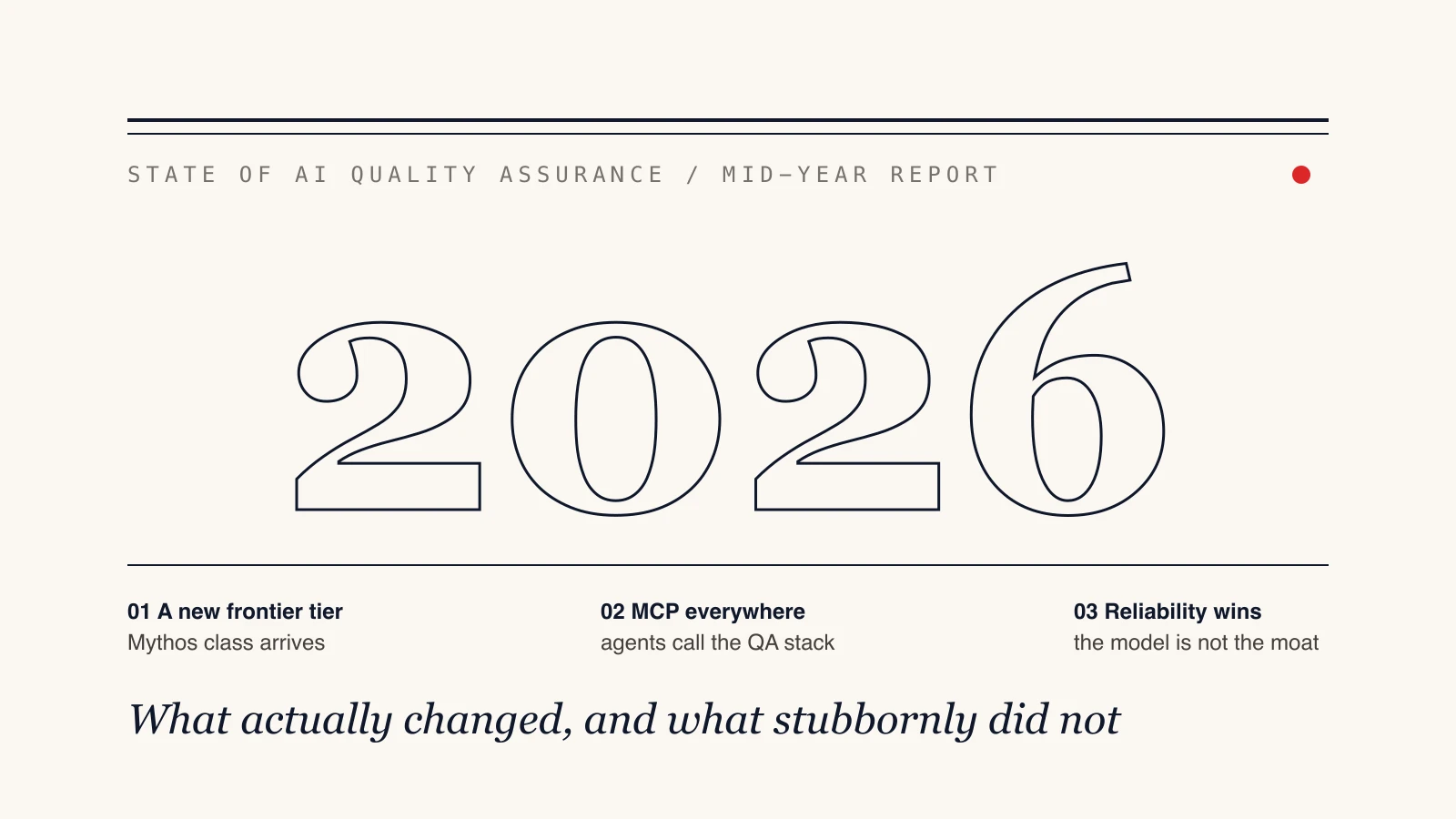
In January we wrote up the state of AI for quality assurance and the verdict was: it works, but only if you build for it specifically. Six months later that conclusion still stands, and almost everything around it moved. This is the mid-year update: five things that actually changed in AI quality assurance in the first half of 2026, and the two things that stubbornly did not.
1. The model ceiling jumped a tier, then kept jumping
In January the model field topped out at Opus-class models trading single points on benchmarks. June brought Claude Fable 5, the first generally available model from Anthropic's Mythos class, and the first launch in over a year where the gap was generational: 11 points over its own stablemate on SWE-bench Pro, and long-horizon coherence that survives the multi-hour agentic sessions that used to fall apart.
Then the cadence sped up. July alone added two more frontier-class options, each cheaper than the last. GPT-5.6 Sol arrived on the 9th with the best published browser-agent numbers and half of Fable 5's rate card. Opus 5 followed on the 24th, pulling near-frontier capability down to the Opus tier at, again, half of Fable 5's price. Three top-end models in two months, and each launch was as much a story about cost as about capability.
For QA specifically, the fine print mattered more than the headline, and it held across all three. Computer use improved by increments, not leaps (Fable 5 at 85.0 on OSWorld-Verified, 1.6 points over Opus 4.8), and the July launches moved price and coding scores more than the browser-reliability numbers a test suite actually rides on. Our own mid-year benchmark confirmed it on real browser plans: on routine tests the new tier buys nothing, and on long ambiguous journeys it is the only model that holds above 90%. Model routing by step difficulty went from optimization to table stakes.
2. MCP became the default way agents touch browsers
In January, giving an AI agent browser control meant picking a framework and wiring it yourself. By mid-year, the Model Context Protocol quietly won the interface war: Playwright MCP as the automation standard, Chrome DevTools MCP for debugging-first workflows with its autoConnect handoff, and Claude's Chrome extension putting an agent inside the user's real browser session.
The second-order effect matters for QA: testing platforms became MCP servers themselves. Your coding agent can now create a test plan, trigger a run, and read the failure evidence over the same protocol it uses to edit code. The QA tool stopped being a dashboard you visit and started being a tool your agent calls.
3. Token economics forced the CLI turn
The first half of 2026 made one cost lesson unavoidable: streaming full page snapshots into a model's context is the expensive way to drive a browser. Microsoft's own guidance now points high-throughput coding agents at Playwright CLI over MCP, and Vercel shipped agent-browser, a Rust CLI built entirely around compact snapshots and disk-side state. The 4-10x token gap between the two styles is now a design constraint everyone builds against, including us: what a model sees per step is a budget, not a firehose.
4. Self-healing started meaning something specific
"Self-healing" spent years as a euphemism for locator fallback. This year the term split in two. Locator-based platforms still mean "try another selector." Agent-based systems now mean something stronger: when a test fails for a reason the evidence can explain, the system proposes and verifies a fix for the test itself, diffing what changed and re-running to confirm. The difference shows up in the maintenance line: repairing selectors is a weekly tax, while reviewing a proposed fix is an occasional click. Buyers have started asking which of the two a vendor means, which is progress.
5. Vibe coding made the testing gap mainstream
The vibe coding wave kept its pace (the numbers we cited in February have only grown), and it dragged the testing conversation with it. When 63% of the people shipping software are not career developers, "write a Playwright suite" is not advice, it is a refusal. The response was the rise of vibe testing as a real category: plain-English behavioral tests executed by agents, sitting at the same abstraction level as the code generation that made them necessary. The testing gap is still wide. But for the first time the tooling on the testing side speaks the same language as the tooling that created the gap.
What did not change: reliability is still the product
The January piece listed the failure modes of pointing a general-purpose agent at QA: stale DOM, timing traps, infinite recovery loops, context overflow. Every one of them is still lethal in July. Better models raised the ceiling on what an agent can do in a browser, and did almost nothing about the machinery that makes it dependable at 3am in CI: staying synchronized with the page, detecting stuckness, capturing evidence, managing context, degrading gracefully when a provider hiccups.
Our benchmark data says this plainly: five frontier models pass a routine production plan at 100%, so the model is not the differentiator. What separates a demo from a QA system is everything wrapped around the model. That was January's thesis. It is July's thesis too, with better numbers behind it.
What did not change, part two: credentials still do not belong in prompts
The security posture we argued for in January (inject auth into the browser, never into the model's context) went from opinion to expectation. More agents touching more real systems made the failure mode obvious to everyone. If a testing vendor cannot say where your credentials go during an AI-driven run, that is the answer.
The back half of 2026
Three things we expect by December: model routing inside test runs becomes a standard feature rather than a differentiator, MCP-native QA workflows (agent files the bug, agent re-runs the fix) stop being demos, and the price of routine browser-test execution keeps falling as light-tier models absorb more of the step mix. The direction of the year is consistent: the intelligence is increasingly a commodity, and the reliability layer is increasingly the product.
See what a purpose-built AI QA stack feels like: describe a test in plain English, get evidence back in minutes. Try Test-Lab free.
Related reading:
- The state of AI for quality assurance - the January baseline this update measures against
- The 2026 mid-year browser agent benchmark - the data behind "the model is not the differentiator"
- Tests that fix themselves - what self-healing means when it is not a euphemism